Friday, April 3, 2020

Legends of the Izkaloteka


In icuitlacuah oquipantiac in tlapetlanilli.

Le pego el relámpago en la
cuitlacuaitl, en la pura nuca, but by that time it was too late.


They had already begun to laugh out loud, and that beginning was the very first wispy whisper of the roaring wind of their resistance, which came to be later documented in the Archives of Áztlan under the chapter known as the Atecocoli, a chapter which had neither beginning nor ending but kept on growing in remembrance and aspirations as the tale tellers grew, yes, grew older as the elders.

It was too late to expect for federal recognition from the United States government as “Native Americans” and being exactly 160 years after the Treaty of Guadalupe Hidalgo (1848), the government of the Republic of the United Mexican States would never flinch now to explain why or how as a political sovereignty recognized within the United Nations system, how could they (as States) transfer territorial integrity to the government in Washington, DC over lands, rivers, mountains, caves, glaciers, and entire ecosystems that they never even knew the name of, except only as shadow provinces of a New Spain that never made it past Geronimo into the New World, tracing projections of the way points of Americo Vespucci, Adams, and Onis.

“Sabes what?”  He said, not questioned but said as only a truly close relative might, could and did say: “Sabes what?”  He began asking out loud to the other ones, who there were not that many (they were not the masses, but only the surviving veteranos of the Movimiento Chicano), as a matter of fact at times there were only a few, or two, or an even one.


It was the multitude in miniature.

“Do you realize we live in the age of Abya Yala?”


He said it out loud but the question part of it went inward to return again four decades later (Gregorian) understanding that it was not resistance but fulfillment that created the high and low pressure zones, states of correlating social sciences trying to account for the lack of human relationship as human beings (what else?) across the territory of the lands of Abya Yala. [AKA: the Americas].

“We are no longer in America.” It was a declaration of voluntary departure. “We no longer live in America, this is now the age of Abya Yala”, and it was a statement of celebration in the powerful hushed tone of reverence and just simple luck to have lived long enough to sense it, see it, and realize that they had become the veteranos of the movement in spite of it all and because of it all.  Because of it all, La Causa had called and they had not resisted but fulfilled its mandate to go where all men and all women had gone before, those who had the good sense to go before and become the ancestors of those of us now going to find out just how they did it, how did they fulfill their love for life and humanity, and so they said it again repeating:

“Let us say with absolutely no risk of sounding ridiculous that the true revolutionary is guided by great feelings of love.”

It sounded good but in actuality the preference was for: 

“Prefiero morir de risa que vivir sufriendo.” 

And so it began, once, again.  Beginning with an echo, the laughter came out with that wispy nostalgia, whispering the question loudly in clear free flight, and with night sky of the desert wind for a trail:  “Where have you been?” 

I was trying to remember.  Already I was trying to remember what it was like to live in America before the Age of Abya Yala.


Chapter 1. Cemhueytlalpan - Pangaea


******************************************************************************http://aulex.org/nah-es/?busca=continente&idioma=en
hueytlalpan:  continente m  continent

ixachitecatl: indígena americano, nativo americano, amerindio, gente autoctona que habita en las tierras de todo el continenteamericano, desde Alaska y Groelandia, hasta la Patagonia chileno-argentina.

Indigenous person of Ixachitlan, Abya Yala [the Americas], (native american), amerindian, auctocotonous peoples who live in the lands of the entire continent Abya Yala [the Americas], from Alaska and Greenland to Patagonia of Chile and Argentinia. 

Ixachitlan: América (Lugar de la gran tierra), así nombraban los aztecas al continente americano antes de la llegada de los españoles.

Abya Yala [America] (Place of the great land), thus was named by the Azteca the continent before the arrival of the Spaniards.

http://aulex.org/nah-es/?busca=grande 

ixachi: bastante, suficiente, grande, gran, mucho
full, sufficient, great, much, 


*************
Anahuac, Cemanahuac
Hueytlalpan, Cemhueytlalpan


Gaea |ˈjēə|
variant spelling of Gaia (sense 1). Gaia |ˈgīə| |ˈgaɪə| |ˈgʌɪə|

1 (also Gaea, Ge) Greek Mythology the Earth personified as a goddess, daughter of Chaos. She was the mother and wife of Uranus (Heaven); their offspring included the Titans and the Cyclopes. [ORIGIN: Greek, 'Earth.' ]

2 the earth viewed as a vast self-regulating organism. [ORIGIN: 1970s: coined by James Lovelock, at the suggestion of the writer William Golding, from the name of the goddess Gaia.]


DERIVATIVES

Gaian |ˈgaɪən| noun & adjective

******** 
pan-combining form

all-inclusive, esp. in relation to the whole of a continent, racial group, religion, etc. : pan-African | pansexual.
ORIGIN from Greek pan, neuter of pas 'all.'-

There are 5 results for «relampago»


tlahuetequi: rayo m, relámpago m
tlapetlalli: relámpago m
tlapetlanalotl: relámpago m
tlatomitl: rayo m, descarga eléctrica f, relámpago m
tletletl: rayo m, relámpago m


Changing Woman
At one

Time


She found herself among the

Loneliest of speckled clouds,

Hanging by the power of a lightning bolt

To the desert land below that

belonged


To the People, to the O’Odham:

Generations of the Nahuatlaca.


They who had traced her trail,

The echoing footsteps,


Tracks that took

A moon time to appear

And disappear,

Blown back to stardust

By the wind

From the

Sun.


The OrigiNations met,

Formed assembly and adopted

Positions,


Caring for them as if they were

Their own children, which they were.


Particular places where these,

Their children,

Could once again,

Twice,

and then as before,


Emerge reborn –

Eyes clear and

Focused


On the shimmer of her


Sweeping skirt

In departure over the horizon,


Leading the way

Home.


Tupac Enrique Acosta

9/20/02


*********************************************


The Weeping Woman of Flower Bone and Corn

Story by Citlaxochitl Enrique
Graphics by Tupac Enrique Acosta

She sits on heaps of trash weeping for reasons not yet known.
 
Discombobulated concrete, splinters of metal, shards of lost dreams, and slivers of ash, dust and life lay scattered like serpents into miniature Mountains nearby an unarmed pond.


The pond is incredibly shallow and unexpected, walking along you might not see it and fall right in.  There is a lot of beauty in this place, even among all these garbage mountains plants also grow.  A stalk of corn rises up from the Trash Mountains with dignity, it feeds the people and the spirit.


It is a clear day, the fire and glow of the sun present on her skin, brown like the sweet honey nurturing the flesh of the land.  She licks the tear off from her thin lips, she pushes her long black hair away from her face and cries quietly amongst the garbage.  An old Abuelo on a nearby mountain of garbage about a stone’s throw away is playing a flute. The flute is thin and still plays the songs of the ancients.  Pieces of wind, song and freedom are woven into his hair.  Threads of black and white corn silk rest under his ripened and aged Chiapaneco hat.  Dreams and prayers lay on top of his eyelids like obsidian butterflies blooming out of limp, stretched cocoons.  His hands, the hands of a Campesino, brown and strong, aged with earth and corn, sugarcane and exploitation, hold the flute.

Through his breath, corn seeds and pollen are born.
Through his flute flowersongs and prayers blossom.


As tears walk down her face she sits watching the old Abuelo. She reaches down to the ground and picks up a pile of granulated debris and separates two sticks and returns the rest to the ground.  With the two sticks she plays music with the old Abuelo.


Their eyes never meet,

Not once.

The old Abuelo with wind, song and freedom woven into his threads of corn silk hair sits like a calm stone, solid and focused.  He plays his music and through it deer’s dance, maiz de Ocosingo ripens, spirits soar.


The weeping woman of flower, bone, and corn sets her vision upon the shine of the thirsty drumbeat and rock of the Ocosingo Mountains and Hills of Chiapas, the land of the Maya.  Here oppression sharpens its cracked hate and thunder throbs giving birth to pistol and mask, fire and word.


The Zapatistas grow here, dreams of land, justice and freedom soar from the people of the corn, rooted deep into the heart of the land. 

Coffee bean and sugarcane pinch your tongue tonight. 

Your heart will eventually slur out of its slug slumber and you will set it free. You will not forget.


………………………You will not forget.


The weeping woman of flower bone and corn is far from her home, her family, her community.  She is far from her own mountains, her own people.  The people of deer, corn, and fire, cactus, mountain and wind.  Her land where the sun's heat is a force that can move mountains.


The weeping woman returns her thoughts to the mountain and laughs, but only a little, wiping away the tears from her face.  She feels safe and embraced by the land and in a blinks moment she leaves the old Abuelo, the pond and the trash mountains.  She must return to her compañeros, for sure they will be worrying because she left without a breath of permission.


On her way to return she walks into a restaurant, the restaurant is missing a wall, the floor is tiled white and very clean. There is a family sitting together laughing loudly and grabbing their fat bellies.  They are the owners.  The weeping woman of flower, bone, and corn walks right past them into the bathroom.  The bathroom is unusually extravagant for Ocosingo, there is running water, a toilet with a toilet seat, toilet paper and even a mirror.


The Woman of flower bone and corn who is no longer weeping stares into the mirror at a woman she does not recognize.  Pitayas, Cactus, and  love grow off of the branches of her mind.  They tear through the mist and the fog of the Chiapas sky.  She washes off the tears erasing them from her face.


The Woman of flower, bone and corn walks back, picking up bolts and stones off of the earth.   There is a lot of construction going on here in Ocosingo, but construction equals destruction and poverty shaves and burns the lives of all.


Her compañeros don’t recognize her absence so she returns to the unexpected pond, and the old Abuelo.  She returns to the same spot, the Abuelo with wind, song and freedom woven into the threads of his corn silk hair is gone, all that remains is a memory, a song of earth and corn.


She sits where he once sat and the wrinkles of an aged backpack appear.  The backpack is green and plaid and to the touch of the hand might turn into dust and return to the earth or fly out of restlessness to the stars like newborn hummingbirds and dreams.


A baby girl will be born tonight.

The lost daughter of the sun will be found.

Her eyes will bear flowers of the heart.

Her belly stones of the moon.

Her hair the currents of growth, rivers and oceans.

The Woman of flower, bone and corn opens the corroded backpack of the lost daughter of the sun.  Inside the backpack lay the spirit of the lost girl, she was kidnapped and killed, but now is free.  Her spirit flies and returns home.


The purple corn and hope guide her.

She is free.

She is with the old Abuelo her guardian singing songs of earth and corn. 

Everything sees you here.  You must change how you live they tell me.


This is where your deepest dreams live, out of the struggle.  Like the honey blood of the moon they transform and one day you will find them awaiting you to be released in a green and plaid backpack in an unexpected pond amongst the mountains of garbage in Ocosingo.
 

If you carry them they will carry you, and amongst the purple corn they will reveal themselves.


You will be the only one who will see it weeping woman.


The old peoples will know.


Story written by: the children of the trash mountains
Citlaxochitl Enrique 2005

Friday, May 24, 2019

The Phoenix


The Phoenix


"In Nocal, In Mochan"
 

DOWNLOAD PDF

There is a fire that burns eternally within the being of humanity at the global level, the light of which does not cast shadow but reveals the integrity of all.  We, the Indigenous Peoples who are the caretakers of this hearth of community, hold the fireplace of this world of mysterious beauty and power to be our home planet, our mother, the Earth.  In this sense, from this perspective we are all originally and eventually, Indigenous Peoples.  The question is, what value do we assign to this ecological principle of human and cultural identity, the origination of all our societies without exception, and why is this even important.

As community members of the Valley of the Sun, we have a unique opportunity to dialogue regarding this question.  Our presence and participation in the demographic and ecological transformation which is evident across the territory bestows a responsibility to act strategically in furtherance of the community development goals which unite us here today.

What are the elements of our community development initiatives? What is the historical and geographic context?  What are the ecological and territorial imperatives if we are to view community urban development as integral to community sustainability over generations?


There is a meter in the community development process that is paced and best served when the body of the organization has achieved the internal maturity necessary to grow and sustain the next phase. This strength is only captured as an asset when challenges are honestly met and effectively addressed.  An issue of relevance usually ignored is that the nonprofit model of community development corporation depends on the for-profit corporate model for its point of reference in terms of identity.

With the form comes a process that must be dealt with, but where is the allegiance?  This is a broad question, and it is meant to be so.  Today we speak of the global economy at the drop of a dollar without ever considering or mentioning the psychology of globalizing communities. And not just as jornaleros (day laborers), migrant workers, economic refugees or transnational corporates and government politicos.


Somewhere there is a myth or a fairy tale or a horror story (take your pick) told about the NEW WORLD, and what happened to people when they crossed over into the territory.  Of course, it always was a global economy.  It has always been one land, one water, one air, and all of the fullness and richness of life are integral to the reciprocal processes which include ourselves - the human beings - as part of the family of the web of life.

And to BE HUMAN? Do we have the courage to enter the fire of the hearth of humanity, to reemerge with the social skills and necessary organizational strategy to renew societies of sustainability and mutual respect?

The bottom line exists, but it is not a line. It is a discovery of reality, a recognition of the economic principles which are sustained by the currency of caring. It is the foundation of individual understanding and cultural infrastructure that reminds us where it all began, so that we may be guided in our pursuit of true community wealth and prosperity, and not remain lost and wandering for another five hundred years.


************************

Seven Global Currencies of the Indigenous Peoples

Life Sustaining Systems of Exchange and Reciprocity
An Evaluation Matrix for the Global Economy and Millennium Development Goals
The Breath of Life
The Water of Life
The Givers of Life
The Sustainers of Life
The Foundation of Life
The Sharers of Life
The Seed of Life
*************************************
The Breath of Life: The Air, Winds and Atmosphere
The Water of Life: The Waters, the Clouds, Waterways, Rivers and Streams, and Oceans
The Givers of Life: The Sacred Species: Buffalo, Deer, Salmon, and Eagle
The Sustainers of Life: Corn, Beans. Squash (agriculture)
The Foundation of Life: The Land and Territory, Mother Earth
The Sharers of Life: Community and Nations
The Seed of Life: Spirit –Light


The Tides of Time


Everyday in the news we hear of the global economy, of events that take place around the world that affect our economic reality as nations, communities and families. It is a great challenge to educate and prepare our youth to encounter success in the future of an increasingly global economic society. To participate in the construction of the future, and not just be dragged along by the effects is one of the principal and practical goals of education. In reality, it has always been a global economy. Traditional indigenous cultures from around the world have always maintained that it is only one earth, one water, one air, and one sun that nourishes us all, and all economic systems reflect this reality as the bottom line – which is not a really a line but a formula, an equation.

What are the factors of this equation? Technology is one, but should not be the prime determinant. Neither should the monetary policies of the World Trade Organization, the World Bank, the International Monetary Fund or the government states be given the exclusive power of determining the value systems by which we identify and implement the economic currencies of humanity.

Seas of Emergence

The term economy gives us a clue by the root “ECO” which also serves in defining the term ECOLOGY. (From the Greek “oikos” which means house.) Traditional cultures from around the world maintain that the entirety of the ecosystem of the planet is our “house” which we strive to make a “home”- a chante – with our cultures for the future generations of humanity. From this perspective, the Sun and Earth maintain a primary role in tandem as authors of the equation of life. From this perspective, the tides of time, which we observe and measure with our calendars, serve to remind us of how far we have come on the journey to success, the journey to achieve our global humanity, and how far we have yet to go. 

YouTube:


tonal@tonatierra.org
P.O. Box 24009 Phoenix, AZ 85074


Monday, November 12, 2018

Return to Aztlan

In Nelhuayotl, In Aztlan


In March of 1969 the National Chicano Youth Liberation Conference was organized by the Crusade for Justice in Denver, Colorado. Led by Rodolfo “Corky” Gonzalez, the Crusade for Justice was a major focal point of the Chicano Movement during the lead up to the National Chicano Moratorium in East Los Angeles in 1970. Drawing upon the inspiration and historic example of the Mexican Revolution of 1910-17 and invoking the universal human right of Self Determination as confederations of Original Nations of Indigenous Peoples, the National Chicano Youth Liberation Conference of 1969 reclaimed the diverse indigenous roots of the participating Chicano Pueblos in a continental geo-political project of nationhood and self-determination known as the Plan Espiritual de Aztlan.


The struggle for liberation as Indigenous Mexican Peoples, the struggle of Aztlan, was not a new struggle. In 1813, in Chilpancingo, Guerrero, Mexico the Congreso de Anáhuac made the first historical proclamation of the Independence of Mexico from the Crown of Spain. At the time, the historical geographic designation of Anáhuac extended into the northern reaches of the territories of the Uto-Aztecan language families with their respective Original Nations of Indigenous Peoples.  Among these Uto-Aztecan families of native nations are the Utes of what is now known as the state of Colorado.

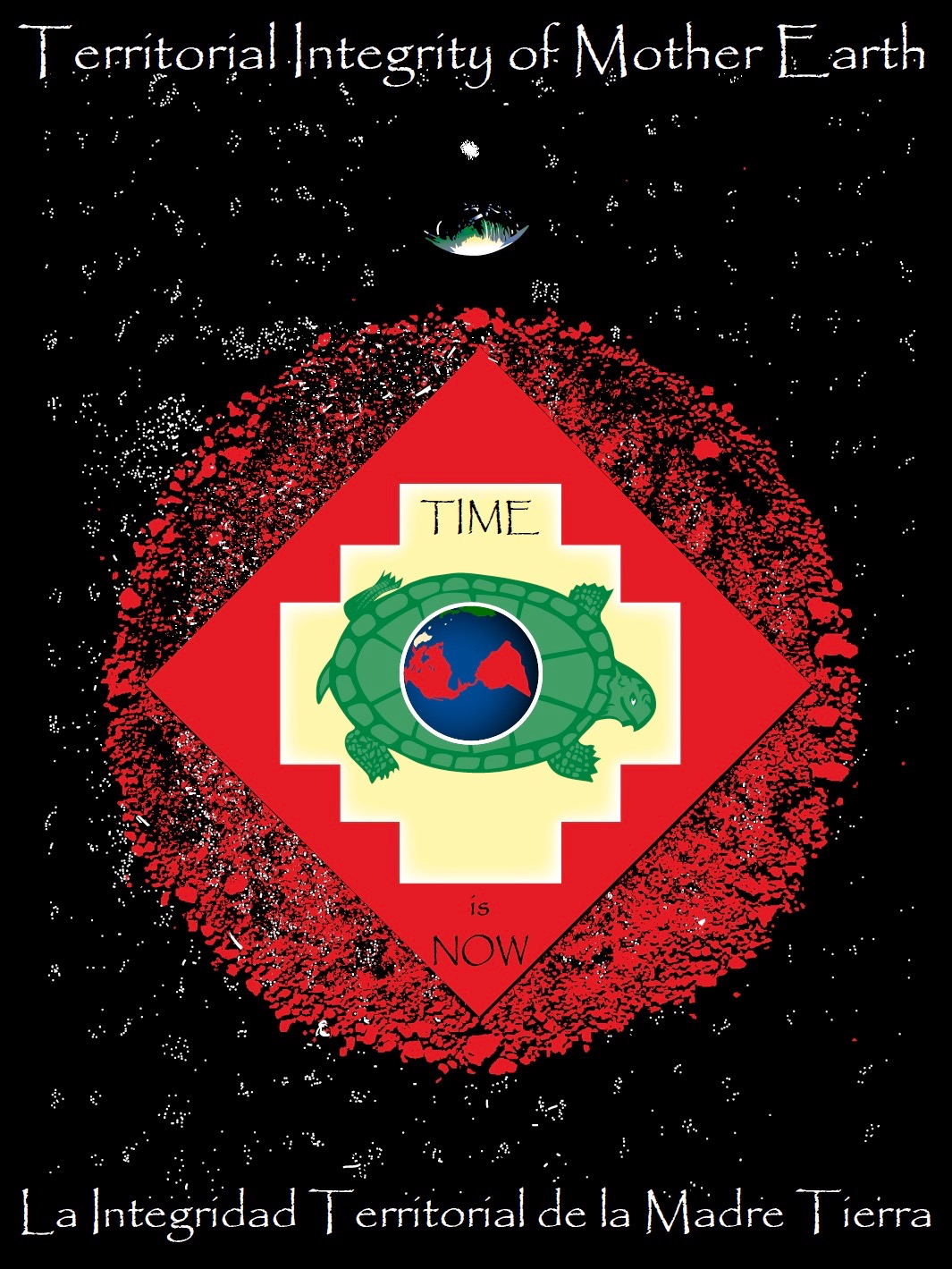
The proclamation of the Plan Espiritual de Aztlan in 1969 is an echo of the declaration by the Congreso de Anáhuac in 1813. It is an echo that returns now fifty years later even stronger in power and purpose, in vision and resonance in order to regenerate the memory, indigenous consciousness, and political will of Continental Confederacy and Indigenous Nationhood in responsibility as defenders of the Territorial Integrity of Mother Earth.


Statement of the Keeper of the Hopi Fire Clan Tablets

Keeper of the Fire Clan Tablets
The Public Statement of the Keeper of the Hopi Fire Clan Tablets, during his Prophetic Mission to the New Mexico State Capital at Santa Fe, December 1990

The Spanish, the Mexican, and the United States governments have all fought over someone else's land without consulting the original native peoples living on it, then created some kind of document. But what of the rights of the original native peoples? Who has the ability to look into this, and see that the basic rights of the Hopi and other native peoples are restored?

This is the key to the problem that threatens all life on earth. If someone can uncover this information and bring it before the world, it might be possible to reverse the destruction of the native cultures that lies at the root of the devastation that now threatens our entire world.


The Chicano Moratorium of 1970 in East Los Angeles

To be continued….

Tupak Huehuecoyotl 


***********************
YouTube:
Return to Aztlan


Eventually, while the reductionist and materialistic descriptions of the quantum wave functions refer to the “collapse” into singularity, the vision and science of Xinachtli records the history as a memory of emergence, a creation story. A creation story that is uninterrupted by the cycles of time and the horizons of space, a continuity of consciousness that regenerates itself from within its own possibilities, probabilities, and intentions to finally reflect and inflect the reference of our Nican Tlacah Earth Born reality.  Cemanahuac Tonantzin: the articulation and systemic communications of the Nahui Ollin cuadralogue via the four phases of Quetzalcoatl (energy-matter): Solid-Liquid : Gaseous-Plasma.


Earth-Water : Wind-Fire

The Mestizo Concept:

A Product of European Imperialism

By Jack Forbes


"Y mis hijos -  
Que les pasará?
Reconocerán la
lucha
de sus tatas?
Sentirán el calor de
su historia indígena,
como yo los enseñe?
Serán ahogados
en el río
de la historia europea, o
nomás
mojados?"


 500 Años del Pueblo Chicano, p.235


Friday, October 19, 2018

The Legend of Truth and the Doctrines of Power

By Tupac Enrique Acosta
September 16, 2003


Legend is the loom of history.  As was narrated thousands of times by the eminent mythologist of the West, Joseph Campbell, all of the cultures and nations of the world encounter one another in the process of weaving a collective conscience, a legend of the future - a design that that emerges from the dual axis of the need of the human being to comprehend the reality of our nature, and at the same time, the nature of reality.

In the world of Legend, there is law and there is also a boundary in the form of a shoreline.  The law proclaims that no one can in reality understand the world through attempted isolation; instead it is necessary to give your heart to the world to know who we are as human beings.  The boundary is the horizon of all human knowledge from its historical beginnings in all parts of the planet, yet this is only a boundary which invites us to approach with respect and, if we arrive with the passport of humility, we shall cross to be received in the mysterious house of wisdom.

Should we violate the law, intending to isolate ourselves in castles of arrogance, racism, nationalism, religious prejudice, fear, ignorance and lies we must then deliver the key to our self constructed prison to the Sheriff of the Doctrines of Power.  Perhaps this name is not really appropriate since in truth he HAS NO POWER only the key which we ourselves have given him that opens the door to liberation.

(In actuality, the Sheriff presents himself in global cultural matrix as the Nation State.  To occupy our attention, occasionally he will toss into the cell of psychological control the games of chance which are known as electoral campaigns.  Or, alternatively we are sentenced to be sent to fratricidal [all of them] or religious wars [also all of them]).  In this context, within this paradigm of civilization, war and economics are synonymous.
 

A few intend escape.  A few intend to see the world as it really is, without false borders and ordered instead by the real powers of love and justice in ecological balance.  These implement a plan to wake the rest, actualizing political campaigns such as the “Dream Act” so that it shall be recognized universally that “Education is for all those who work to learn”.  Others, invoking the millennial roots of humanity itself, call to the winds with the shell trumpet of the seven seas – atecocoli – and continue on the path of a global humanity.

Meanwhile back at the ranch, the Sheriff panics to discover a maiden escapee from the prison is headed for the border, and so he urgently calls to alert La Migra (Border Patrol).  The maiden’s identity in the myth is AKA “Snow White”, while La Migra appears as the old, ugly witch who lives in the land of lies and for that reason cannot see - not even her own face, her personality in human terms - in the mirror of the Legend of Truth. 

How the story ends everybody knows, but not yet.  The maiden still sleeps; she has NOT awakened but remains captured by the forces of fear, guilt, and the darkness of isolation which derive from a collective conscience which pretends ignorance of being active accomplice to the Doctrines of Power.  The spell which binds her conscience in coma is the poison of the Domain of Dominion: the prison of patriarchy.

In the traditional songs of our Izkalotlan Pueblo, there is a popular verse which goes:

Even the Suns will die, the Stars shall sacrifice themselves,
Giving their blood which is the Light, offering their flesh
Which is pure Energy,
So that the Spirit
Shall be reborn.


On Saturday September 13th, in their humble home of the NAHAUCALLI, Embassy of Indigenous Peoples, the community voices of the Izkalotekatl who bring the song to life, gathered to invoke the memory of the Legend of Truth in attendance at the Annual Human Rights Conference of TONATIERRA.  The song sings of the prophecy of the Sixth Sun, the Sun of Justice which is now dawning for the Indigenous Peoples of the continent and the world.

In addition to collectively addressing the themes of active community campaigns in the field of Civil Rights such as that of the Dream Act among many others, the issue of Human Rights was presented powerfully by the Macehualli, Jornaleros (Day Laborers) of the community who provided a theatrical presentation of realities of jornalero life, the struggle to organize, and the victory of community.

The theme of this year’s annual conference was Los Hijos de Maiz y el Camino a Cancún, and so it was the youth in attendance who took the lead to implement a direct public action in support of the movement by the Indigenous and Campesino movement mobilized on the very same day in Cancún, México in opposition to the agenda of the World Trade Organization.

A report by the legation of Tlahtokan Aztlan which attended the United Nations Permanent Forum on Indigenous Issues in New York last May was also brought forward and discussed, as well as the work by La Alianza Indígena Sin Fronteras led by José Matus of the Yaqui Nation.  The Black Mesa Water Coalition reported on their work to preserve the sacred aquifers of Black Mesa in the Four Corners area of the Hopi and Navajo Nations, acknowledgement that the dialogue on Civil, Human and Indigenous Rights is at all times referenced by our collective obligations as Indigenous Nations of the territory.

The Doctrines of Power identified and exposed for community tribunal were:

  • The Doctrine of Discovery and the Royal Crowns of Europe – October 12th 1492
  • The Doctrine of Colonization of the Continent and Indigenous Peoples of America 1492-2003
  • The Monroe Doctrine, USA – December 2, 1823
  • The Doctrine of Permanent War, USA – 2003

www.nahuacalli.org

tonal@tonatierra.org
802 N. 7th Street
Phoenix, AZ 85006